🏠 Stay at home! 10% discount on all verified purity peptides


How to Reconstitute Research Peptides: A Laboratory Protocol for Reagent Preparation

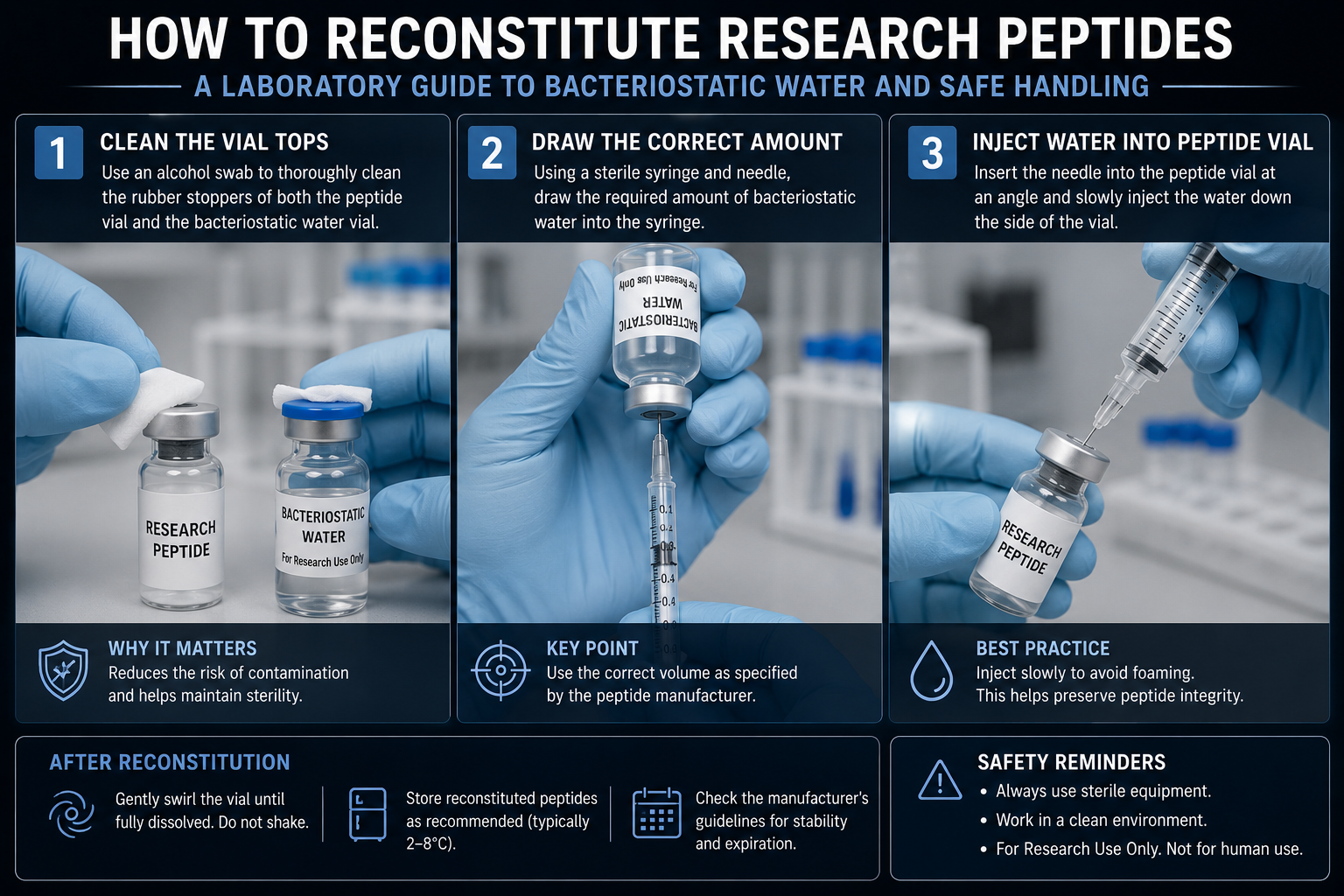
How to Reconstitute Research Peptides: A Laboratory Protocol for Reagent Preparation
Abstract
The reconstitution of lyophilized peptides is a foundational step in preclinical laboratory research. Improper handling, incorrect calculations, or suboptimal solvent selection can cause peptide degradation, precipitation, or loss of biological activity. This document serves as a standard laboratory operating protocol (SOP) for the reconstitution, calculations, and storage of research-grade peptides, ensuring experimental accuracy and reproducibility.
1. Purpose and Scope
This protocol outlines the procedures for converting lyophilized peptide reagents into stable, liquid solutions suitable for in vitro assays and in vivo animal model administration. It covers the physics of peptide preservation, reconstitution math, solvent selection, and storage guidelines.
2. Essential Equipment and Reagents
-
Lyophilized Peptide Vial: Stored at $-20^\circ\text{C}$ or $-80^\circ\text{C}$ prior to use.
-
Reconstitution Solvent: * Bacteriostatic Water ($0.9\%$ benzyl alcohol as a preservative to inhibit bacterial growth in multi-use vials).
-
Sterile Water for Injection (for single-use, cell-culture-sensitive assays).
-
Dilute Acetic Acid ($0.1\% - 1.0\%$) or Dilute Ammonium Hydroxide ($0.1\%$) for hydrophobic peptides.
-
-
Syringes: Ultra-fine, sterile insulin syringes ($0.3\text{ mL}$, $0.5\text{ mL}$, or $1.0\text{ mL}$) with integrated needles to minimize dead space.
-
Disinfectant: $70\%$ Isopropyl alcohol wipes.
3. Reconstitution Calculations: The Reagent Math
To determine the volume of solvent required to achieve a target peptide concentration, use the formula:
$$\text{Volume of Solvent (mL)} = \frac{\text{Mass of Peptide in Vial (mg)}}{\text{Target Concentration (mg/mL)}}$$
Laboratory Example 1: BPC-157 Reconstitution
To reconstitute a $5\text{ mg}$ vial of BPC-157 to a target concentration of $2\text{ mg/mL}$:
$$\text{Volume} = \frac{5\text{ mg}}{2\text{ mg/mL}} = 2.5\text{ mL of solvent}$$
Laboratory Example 2: CJC-1295 Reconstitution
To reconstitute a $2\text{ mg}$ vial of CJC-1295 to a target concentration of $1\text{ mg/mL}$:
$$\text{Volume} = \frac{2\text{ mg}}{1\text{ mg/mL}} = 2.0\text{ mL of solvent}$$
Note: For high-precision dosing, converting milligrams to micrograms ($1\text{ mg} = 1000\ \mu\text{g}$) simplifies the measurement of ultra-low quantities within standard laboratory syringes.
4. Step-by-Step Laboratory Protocol
[Lyophilized Vial]                                [Solvent Vial]
        |                                                |
   (Equilibrate to room temp)                       (Sanitize rubber stopper)
        |                                                |
        +-----------------------+------------------------+
                                |
               Draw calculated solvent into syringe
                                |
               Insert needle at a 45-degree angle
                                |
               Slowly drip solvent down glass wall
                                |
               Gently swirl to dissolve (Do NOT shake)
-
Temperature Equilibration (Crucial): Remove the lyophilized peptide vial from cold storage. Allow it to sit at room temperature for 20–30 minutes before reconstitution. This prevents moisture from condensing inside the vial when opened or punctured, preserving peptide stability.
-
Sanitation: Thoroughly wipe the rubber stoppers of both the peptide vial and the solvent vial with a $70\%$ isopropyl alcohol wipe. Allow to air dry completely.
-
Solvent Extraction: Draw the calculated volume of bacteriostatic (or sterile) water into the syringe, ensuring no air bubbles remain.
-
Controlled Infusion: Insert the syringe needle through the center of the peptide vial's rubber stopper. Do not spray the liquid directly onto the lyophilized powder. Aim the needle toward the glass wall of the vial and slowly release the solvent, allowing it to drip down the side and interact gently with the powder.
-
Vacuum Management: Many lyophilized peptides are sealed under a partial vacuum. If the syringe plunger is pulled in rapidly by the vacuum, hold it back to control the flow and prevent high-pressure degradation of the delicate peptide structure.
-
Dissolution: Remove the syringe. Gently swirl the vial in a slow, circular motion. Do not shake the vial. Shaking creates shear forces that can denature the tertiary structure of proteins and delicate peptides, forming insoluble aggregate foams. Let the vial stand on the laboratory bench for 5–10 minutes until the solution is completely clear and free of particles.
5. Troubleshooting Hydrophobic Peptides
Some peptides are highly hydrophobic and will not dissolve in water alone, appearing cloudy or forming visible particles.
-
Acidic Peptides: If the peptide sequence has an abundance of acidic residues (e.g., AOD-9604, Tesamorelin under certain conditions), add a tiny drop ($10–50\ \mu\text{L}$) of sterile $0.1\%$ acetic acid. Swirl gently, then dilute with bacteriostatic water.
-
Basic Peptides: If the peptide contains an abundance of basic amino acids, a drop of sterile $0.1\%$ ammonium hydroxide can facilitate rapid dissolution prior to final water dilution.
6. Storage and Aliquoting Protocol
-
Refrigeration: Store reconstituted peptides at $2^\circ\text{C}$ to $8^\circ\text{C}$ inside a laboratory refrigerator. Minimize vibration and light exposure.
-
Aliquoting (Highly Recommended): If the peptide solution will not be fully used within 7–14 days, divide the liquid into sterile microcentrifuge tubes (aliquots) and freeze them at $-20^\circ\text{C}$ or $-80^\circ\text{C}$. This avoids the degradation caused by repeated freeze-thaw cycles.